
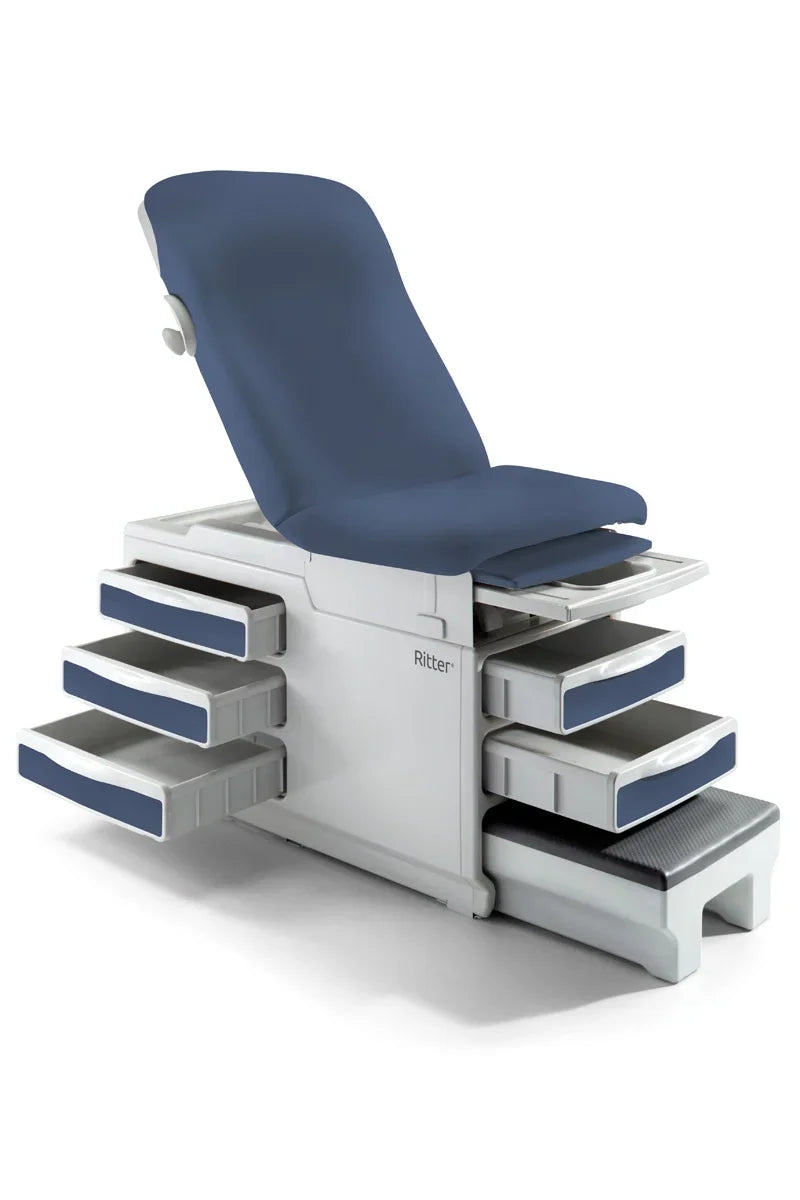
An exam table is the piece of furniture every patient touches, and the wrong one shows up quickly: patients who struggle to get on it, staff who strain to help them, or a table that doesn't fit the room or the exams you do. These six tips are what we walk customers through before they order, whether they're furnishing a new practice or replacing a worn-out table.
1. Decide between a manual and a power exam table
Manual exam tables stay at a fixed height. Patients climb on with a pull-out step, and the backrest usually adjusts with a gas spring. They cost less, need no outlet and suit general practice, urgent care and school health rooms where most patients can step up on their own. Browse Manual Exam Tables.
Power exam tables (also called hi-lo tables) raise and lower electrically. They lower so patients can sit down and transfer without a step, then raise to a comfortable working height for the clinician. They cost more and need a nearby outlet, but they reduce lifting and strain for staff and make exams easier for older patients and anyone with limited mobility. Browse Power Exam Tables.
Many practices put a power table in at least one room for patients who need it and use manual tables elsewhere.
2. Plan for patient access and barrier-free height
The height a patient transfers from matters as much as anything else. A barrier-free table lowers close to wheelchair seat height, so a patient can slide across rather than climb.
- Know the standard. In 2024 the Department of Justice adopted the U.S. Access Board's standards for accessible medical diagnostic equipment for state and local government health providers under ADA Title II, including a low transfer height of 17 to 19 inches. Many private practices use the same benchmark when choosing accessible equipment.
- Check the low height in the specs. The Midmark Ritter 228 and Ritter 229 lower to 17 inches with a 28-inch-wide transfer surface. The Ritter 224 lowers to 18 inches.
- Think about the transfer itself. Look for a wide seat, grab handles or side rails, and controls staff can reach while assisting the patient.
3. Match weight capacity and table size to your patients
Weight capacity is a safety rating, not a suggestion. Choose a table rated above the heaviest patients you expect to see.
- Standard tables such as the Ritter 204, Brewer Versa and UMF 5250 are rated for 500 lb.
- Higher-capacity tables go further. Brewer Access tables come in 700 lb versions, and the UMF 5005 bariatric power table is rated for 800 lb. See Bariatric Tables.
- Pediatric practices often choose tables designed for children, including Clinton treatment and scale tables with child-friendly graphics. See Pediatric Exam Tables.
4. Check the features your exams actually need
Two tables can look alike and work very differently in a busy room. List the exams you do most, then check for:
- Back adjustment. Gas-spring (pneumatic) backs are standard on manual tables; a power back saves effort when you reposition patients often.
- Stirrups and pelvic tilt. Needed for OB/GYN and many women's health exams. The Ritter 204-012 adds a pelvic tilt and drawer heater to the standard 204.
- Storage. Pass-through drawers that open from either side keep supplies within reach. The UMF 5250 has reversible side and front drawers.
- Power and comfort extras. Built-in receptacles for instruments, a drawer heater to warm instruments, and foot or hand controls on power tables.
- Upholstery. Seamless tops are easier to clean and disinfect. Check color options and whether the top is included or sold separately.
5. Measure the room and plan the delivery
- Floor space. Leave room to walk around the table and for a wheelchair to approach the side where patients transfer.
- Small rooms. Space-saver tables such as the Clinton 8844 Step-Up Space Saver fit tight exam rooms.
- Outlet. Power tables need a nearby outlet; avoid running cords across the floor.
- Delivery and lead time. Exam tables ship by freight. In-stock tables such as the Ritter 204, Ritter 228 and 229, and Q-400 ship from our warehouse; made-to-order tables take longer, so ask about lead time if you have an opening date.
6. Decide between new and refurbished, and compare warranties
- New gives you the current model, the full factory warranty and the full service life ahead of you. Clinton tables, for example, carry a 3-year warranty on mechanical and electric components.
- Refurbished power tables can cost far less than new. Our refurbished Midmark Ritter 224 chairs are inspected before they ship.
- Ask what's covered. Check warranty length, whether upholstery is included, and who services the table if something goes wrong.
Popular exam tables at a glance
| Model | Type | Capacity | Best for | Price |
|---|---|---|---|---|
| Clinton 8890 Family Practice | Manual | See listing | Budget-friendly general practice rooms | from $795 |
| Brewer Versa | Manual | 500 lb | Everyday exams, pass-through storage | from $1,920 |
| Ritter by Midmark 204 | Manual | 500 lb | Primary care and women's health; in stock | from $2,149 |
| Q-400 Power Hi-Lo | Power | See listing | Affordable power table; in stock | $2,595 |
| Midmark Ritter 224 (refurbished) | Power, barrier-free | 500 lb | Accessible exams on a budget | from $2,950 |
| Midmark Ritter 228 | Power, barrier-free | 500 lb | 17" low height; in stock | from $5,700 |
| UMF 5005 Bariatric | Power, bariatric | 800 lb | Bariatric patients | $9,033 |
Prices as of November 2026. See every model in our Exam Tables collection.
Before you order: a quick checklist
- Manual or power decided, by room
- Low transfer height checked for patients with limited mobility
- Weight capacity above your heaviest patients
- Stirrups, pelvic tilt, drawers and receptacles matched to your exams
- Room size, wheelchair approach and outlet checked
- Lead time confirmed against your opening date
- New vs refurbished decided, warranty compared
Frequently asked questions
How much does an exam table cost? Manual exam tables start under $1,000 for basic models and run to about $2,500 for premium tables with storage and upholstery. Power and barrier-free tables typically range from about $2,600 to $10,000 or more, and bariatric models cost more.
What's the difference between a manual and a power exam table? A manual table stays at one height and patients use a step. A power table raises and lowers electrically so patients can transfer at a lower height.
What is a barrier-free exam table? A power table or exam chair that lowers close to wheelchair seat height so patients can transfer without climbing. The federal accessibility standard for medical diagnostic equipment uses a low transfer height of 17 to 19 inches.
How much weight can an exam table hold? Most standard tables are rated for 500 lb. Bariatric models go higher, some to 700 or 800 lb. Always check the listing.
Do you sell refurbished exam tables? Yes. Our refurbished tables are inspected before they ship.
Talk to an exam room specialist
Not sure which table fits your rooms? Call us at (973) 521-8769, Monday to Friday, 8 AM to 5 PM ET, or browse our exam tables. As an authorized dealer for Midmark, Clinton, Brewer and UMF Medical, we'll help you choose, tell you about any current factory promotions, then ship it and support it after the sale.